Delight ERM
A centralized enterprise risk management platform that gives your organization one unified view of risk, control and compliance – across every department.
See Every Risk Before It Becomes a Problem
Delight ERM is a comprehensive Enterprise Risk Management platform designed to help organizations proactively identify, assess, monitor, and mitigate risks across all business functions through a centralized, structured framework. The platform provides a unified view of enterprise-wide risks, enabling management teams to make informed decisions, strengthen best practices, ensure regulatory compliance, and improve organizational processes.
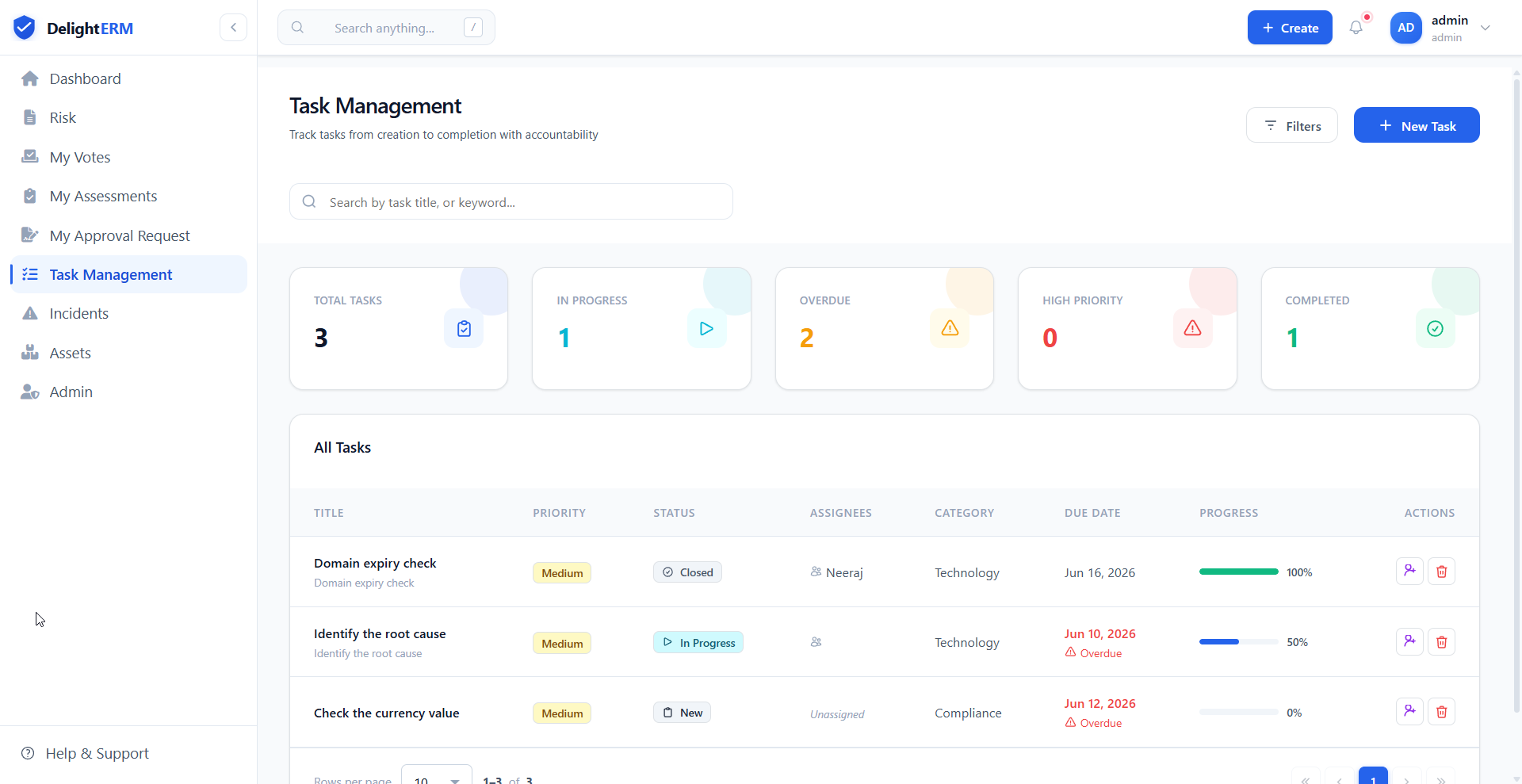

A Centralized Risk Management Platform
Everything your risk team needs, in one place.
Enterprise Risk Register
Risk Assessment & Analysis
Control Management
Incident Management
Knowledge Management
Task Management
Voting Management
Assessment
Approval Management
Asset Management
Action Plan Monitoring
Analytics & Reporting
Notifications & Alerts
Executive Dashboards
Identify. Assess. Manage. Mitigate. Monitor.
Delight ERM is built around a continuous risk management cycle – so risk isn’t handled once and forgotten, but tracked and improved at every stage.
Communicate risk status and trends; provide insights for informed decisions.
Track risks and mitigation progress; monitor changes and emerging risks.
Corrective actions, preventive controls, target dates.
Assign risk owners and define responsibilities.
Create and categorize risks; define risk descriptions and business impact.
Likelihood assessment, impact assessment, automated risk scoring.
A Structured, End-to-End Risk Process
From first identifying a risk to continuously improving how you manage it — Delight ERM guides your team through every stage of the risk lifecycle.
Risk Identification
Risk Assessment
Control Evaluation
Risk Mitigation
Monitoring & Review
Reporting & Compliance
Continuous Improvement
Why Choose Delight ERM?

Some of the Best Brands Trust Us
Delight ERM is trusted by 300+ customers across 500+ projects – from enterprises to public sector organizations.






What Our Clients Say About Us
The experience working with DM World was amazing the entire team was very competent and we managed to implement both CRM and Call Centre System within a very short period. Thank you DM World for the job well done.
Ready to Take Control of Enterprise Risk?
Talk to our team and see how Delight ERM can bring every risk, control and action into one place for your organization.
Frequently Asked Question
What is Delight ERM?
Delight ERM is a comprehensive Enterprise Risk Management platform designed to help organizations proactively identify, assess, monitor and mitigate risks across all business functions through a centralized and structured framework. It gives management teams a unified view of enterprise-wide risks so they can make informed decisions and stay compliant, rather than managing risk reactively after something goes wrong.
Who makes Delight ERM?
Delight ERM is built by DM World, an ISO 27001:2022 and 9001:2015 certified software solutions company headquartered in Dubai, with sales operations across Africa. DM World’s core capabilities span Customer Experience Management, Business Applications and Cyber Security Solutions, and they’ve completed 500+ projects for 300+ customers globally.
What modules does Delight ERM include?
Delight ERM covers the full risk lifecycle through modules including Enterprise Risk Register, Risk Assessment & Analysis, Control Management, Incident Management, Knowledge Management, Task Management, Voting Management, Approval Management, Asset Management, Action Plan Monitoring, Analytics & Reporting, Notifications & Alerts and Executive Dashboards. Together, these give organizations everything needed to identify, evaluate, and act on risk without switching between separate tools.
Is Delight ERM cloud-based and can it scale for large organizations?
Yes, DelightERM is built as a Cloud & SaaS Solution with a secure & scalable architecture, meaning it’s designed to grow alongside an organization rather than needing to be replaced as risk volume increases. It also supports multi-department risk management, so large organizations with several business units can manage risk centrally while still capturing department-specific detail.
What is enterprise risk management?
Enterprise risk management (ERM) is a structured approach organizations use to identify, assess, monitor and mitigate risks across every business function, not just within one department. Instead of handling risks in isolated silos, ERM gives leadership a single, unified view of all enterprise-wide risks, so decisions are made with the full picture in mind. The goal is to move from reacting to problems after they happen to catching them before they impact business objectives.
What is enterprise risk management in healthcare?
In healthcare, enterprise risk management means identifying and managing risks that affect patient safety, regulatory compliance, data privacy and operational continuity. All under one framework rather than handling clinical, financial and IT risks separately. This typically includes tracking incidents, monitoring compliance with health regulations and ensuring corrective actions are followed through across departments like clinical operations, IT, and administration. A centralized ERM platform helps healthcare organizations respond faster to patient safety incidents while staying audit-ready for regulatory reviews.
What are the benefits of enterprise risk management?
The core benefits are better decision-making, stronger regulatory compliance and fewer costly surprises. Effective risk assessment specifically enables proactive risk management, improves decision-making and resource allocation, enhances regulatory compliance and governance, reduces potential financial and operational losses, and strengthens organizational resilience. Beyond that, ERM creates accountability – every risk has a clear owner and a tracked mitigation plan, so nothing quietly falls through the cracks.
What is enterprise risk management in banks?
For banks, ERM means managing credit risk, operational risk, compliance and cybersecurity risk within one integrated framework, since a failure in any one area can quickly threaten the whole institution. Banks lean heavily on real-time monitoring and automated alerts to catch emerging risks like unusual transaction patterns or compliance gaps, before regulators or customers are affected. Given how tightly regulated banking is, ERM platforms here also need strong audit-ready documentation and compliance tracking built in.
How does enterprise risk management differ from traditional risk management?
Traditional risk management usually looks at risks department by department. IT handles cyber risk, finance handles financial risk, and so on, often with little communication between them. Enterprise risk management instead brings all of that into one centralized, structured framework, giving leadership a single view across the whole organization instead of fragmented reports. This shift is what allows companies to move from reactive, siloed risk handling to a genuinely proactive risk management culture.
How do you implement enterprise risk management?
Implementation typically follows a clear cycle: identify risks and categorize them, assess their likelihood and impact, assign an owner to each one, build a mitigation plan with target dates, then continuously monitor and report on progress. Most organizations start with a requirement study to understand their specific pain points and existing processes before rolling out training and a phased deployment. The key is treating it as an ongoing culture shift, not a one-time project.
How do you integrate information security with enterprise risk management?
Information security risks like data breaches or system vulnerabilities should be logged, assessed and tracked in the same centralized risk register as every other business risk, not managed in a separate silo by IT alone. This means cybersecurity incidents feed into the same risk scoring, control evaluation and mitigation planning workflow used across the organization, giving leadership visibility into how security risk compares to financial or operational risk. Real-time alerts and incident management modules are especially important here, since security risks often need a faster response time than other risk categories.
How do companies automate risk assessments using ERM platforms?
Modern ERM platforms automate risk assessments through automated risk scoring, where likelihood and impact ratings are combined into a consistent score without manual calculation. They also use automated alerts and notifications to flag emerging risks or overdue mitigation actions without anyone needing to manually check status and executive dashboards that pull live data into heat maps and trend charts automatically. This reduces the manual reporting burden and means risk data stays current instead of only being accurate right after a quarterly review.
How do financial institutions choose an ERM platform?
Financial institutions typically prioritize platforms with strong regulatory compliance tracking, audit-ready documentation and secure, scalable architecture, since they’re held to strict regulatory standards and handle sensitive data. Real-time monitoring and automated reporting also matter a lot here, since financial risks can escalate quickly and regulators expect timely, accurate disclosure. Cloud-based, configurable platforms tend to be favored because they can adapt to different regulatory frameworks across regions without needing custom development each time.
How do top ERM platforms identify risk?
Leading ERM platforms combine a centralized risk register with department-wise risk capture, so risks are logged consistently no matter which team identifies them first. Many also use risk source analysis and asset-based risk identification to trace exactly where a risk originates – a specific process, system, or asset, rather than just noting a vague concern. Some platforms add a collaborative layer, using structured voting mechanisms where multiple stakeholders weigh in on likelihood and impact, producing a more objective risk assessment than a single person’s judgment.